
Using chinese-language-loader in Vue CLI to Avoid Forgetting Traditional-to-Simplified Conversion
The Problem
Users in mainland China are sensitive to seeing Traditional Chinese characters. When developing front-end pages, it is easy to forget to convert Traditional to Simplified Chinese and accidentally hard-code Traditional Chinese strings into HTML or JS files.
Evaluating the Package
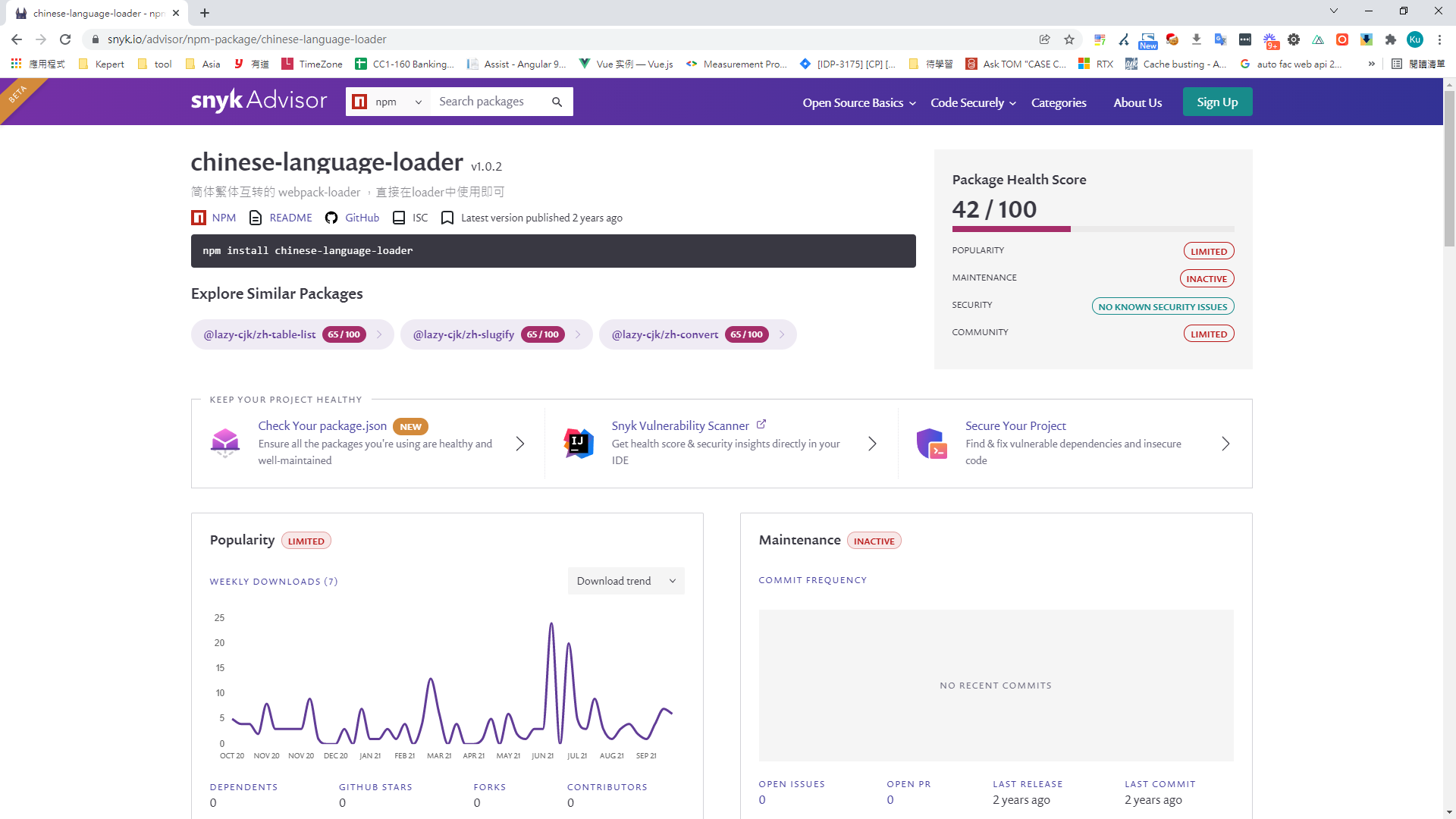 The package does not score very high on Snyk, probably because of low usage. But after reading the source code, the underlying mechanism is a Traditional/Simplified mapping table for character conversion, so it should be safe enough to use.
Install chinese-language-loader
npm install chinese-language-loader --save --devs
Adjust vue.config.js
chainWebpack: config => {
    config.module
      .rule('language')
      .test(/\.(js|vue)$/)
      .use('chinese-language-loader')
      .loader('chinese-language-loader')
      .options({
        language: 'zh-CN'
      })
      .end()
      }
Result
At this point, Traditional Chinese in your .vue and .js files will be converted to Simplified Chinese during bundling.
Bonus: Convert Simplified to Traditional Chinese in JavaScript
import chineseLanguageLoader  from "chinese-language-loader/lib/main.js";
let str = chineseLanguageLoader('红豆生南国,春来发几枝。愿君多采撷,此物最相思。', {language: 'zh-TW'});
console.log(s2tResult)

// 紅豆生南國,春來發幾枝。願君多采擷,此物最相思。


Comments