
The US Navy SEALs have a unique management philosophy for identifying the most suitable leaders by analyzing individual performance and trust in a matrix. First, let's watch a video.
Trust is especially crucial in the following two scenarios:
- A US special forces team deep in the mountains of Afghanistan: In such a challenging and uncertain environment, mutual trust among team members is not only key to completing the mission but also the cornerstone of their survival.
- A fleet on a long-term sea voyage: In such a closed and continuous maritime environment, strong team cohesion and trust are vital factors for ensuring navigational safety and efficiency.
This management philosophy, which uses a matrix to analyze individual performance and trust, reveals several key insights
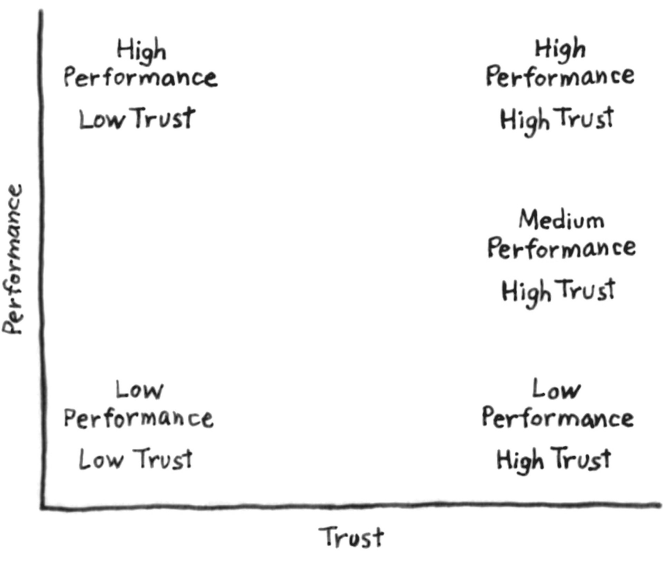
- There are n ways to measure high performance, but there isn't a single method for measuring trust.
- How do you measure trust? What does it look like when you're off the battlefield (behind the scenes)? Can they still be trusted?
- High-performance, low-trust individuals are often detrimental to the team in the long run because they prioritize their own interests. These people are quite easy to find.
- Medium-performance, high-trust individuals are the most suitable leaders. When problems arise, they won't run away; they'll work with you to solve them.
Trusting Teams
People who work together are not necessarily a team. Trust is the courage to be vulnerable, to admit mistakes out loud, and to raise your hand to ask for help. (From The Infinite Game)
How to Build Trust in the Workplace
In the workplace, everyone has an invisible "trust account." When you first join a company, you might start at zero. Through correct behavior and decisions, you can gradually accumulate trust. As your trust balance grows, the resources and professional freedom you can access will change.
How to Increase Others' Trust in You
- Proactively report progress and sync information upon completing tasks.
- Proactively take ownership and be responsible for the outcomes.
- Admit mistakes early and propose preventive measures.
- Demonstrate professionalism in teamwork.
- When encountering unclear issues, take the initiative to clarify them.
- When faced with unreasonable tasks, don't stay silent; proactively communicate and negotiate.
- Have a positive impact on the team. ...
How to Decrease Others' Trust in You
- Doing just enough to get by, without considering quality, simply to mark a task as "done."
- When faced with unknown problems, making no effort to understand and giving careless answers.
- Only doing work that interests you, while ignoring the requirements of the company and your manager.
- Refusing to admit your own mistakes.
- Shifting blame when faced with difficulties.
- Being narcissistic, always thinking your work is perfect.
- Always putting yourself first.
- Having a negative impact on the team. ...
Conclusion
From the management philosophy of the US Navy SEALs, we learn that whether in extreme environments or the everyday workplace, trust and teamwork are the keys to success and failure. By building and maintaining trust, we can not only improve individual and team performance but also create a more harmonious and effective work environment.


Comments